Monday, April 22, 2013

Novel Traveling for the Budget Conscious


Novel Traveling is all about the adventure; it’s about the mysterious and beautiful places (and characters) you meet along the way. Exotic places, far away things which simply don’t exist in our everyday lives. It’s this break from the mundane which can inspire creativity in us.


So then how does a writer on a budget travel to these places? Google Image Search can really only get you so far. Sometimes, you just need some firsthand experience that only visiting a place can give you.


Well fear not, for there is a way to gain this experience without spending hundreds or even thousands of dollars traveling to some foreign, exotic place. I call it: Backyard Traveling.


Allow me to explain. I live in Los Angeles.


LA is one of the biggest cities in the US. Culturally diverse, yes, but somewhat lacking in landscape other than “crowded city.” But for those willing to research a little, there exists places to go which, while perhaps not as fancy as Bali, are very different from what I see everyday.

Though even if you live in Bali, Backyard Traveling is an option. The capital of Bali is Denpasar, a city not unlike Los Angeles. Outside of Denpasar are the more remote regions that tourists rarely travel to. Regions like Singharaja, where beats the artistic heart of Bali. So in a way, no matter where you live in the world, Backyard Traveling is always an option.

To accomplish Backyard Traveling, you need a few things:

1. A place to visit, somewhere local yet out of the ordinary. 
(Frommers.com for your city.)

2. A local, someone who knows the area and is willing to help you out. 
(A friend, or check our list of location experts under "For Writers.")

3. A list of things to do during your travels.

Not a very long list, which is what makes this so easy. I took a Backyard trip recently, so here’s my checklist.

1. Catalina Island, one of the channel islands off the coast of Los Angeles.


2. I’ve been blessed to come to know a woman, Amy Keating-Rogers, who supplied me with knowledge of the island.

3. Mrs. Keating-Rogers also supplied me with a guide to the island that she wrote. The Internet is also a valuable tool.

So now that you have completed your checklist, all that’s left is to pick a date and head out.

What makes Backyard Traveling good for the aspiring Novel Travelist? 

Surely if you want to send your characters on an adventure in the artistic heart of Bali, then what does a little island in the US have to do with that?

The answer is a lot. Catalina Island, despite being only 27 miles from Los Angeles, is vastly different.


It’s a change in scenery, a new adventure, something to kick start inspiration. Then you can consult a fellow Novel Travelist, like Michelle Em (Under "For Writers"), who lived in Bali for further details.

Stuck on what to do next? Use your travels to inspire something. Perhaps wander around somewhere. Need a new location? Relocating yourself can often help you dream up somewhere new to throw your characters. Need a new character? Surrounding yourself with new people helps. Someone you meet can inspire you to make your best character yet.

All in all, a Backyard Trip can be just the thing to either inspire a new story, or help you out of a rut in your current one.  It’s cheap and easy, so even the Novel Travelist on a budget can head somewhere and have a real life adventure.

Credit for the information on Bali goes to: Michele Em, a Novel Travelist location expert listed under “For Writers.”

Friday, April 19, 2013

Unconventional Meet-Cute Site: Damnoen Saduak Floating Market


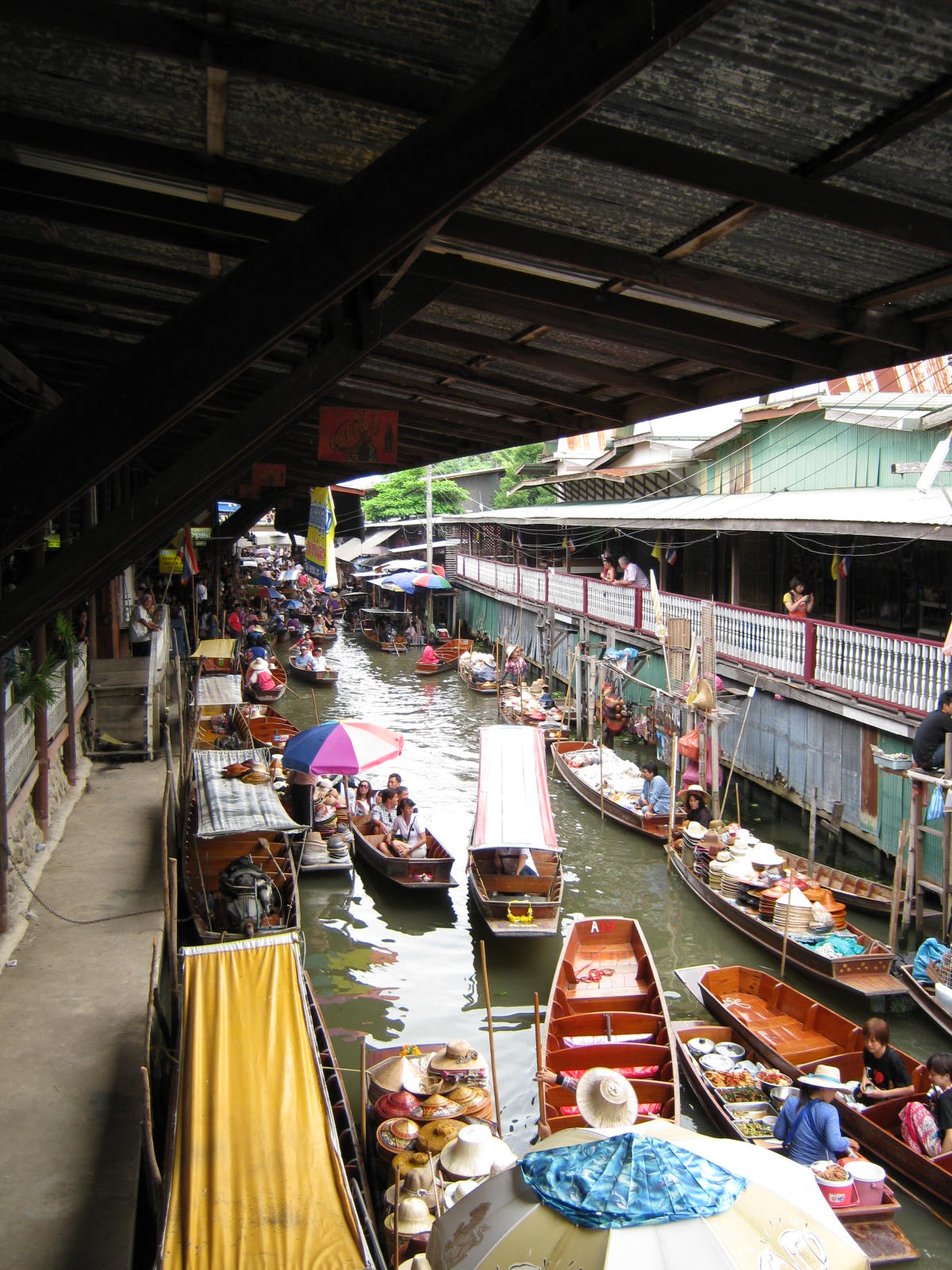
Are your characters heading down to Southeast Asia for quest or a vacation? Specifically Thailand? Have them visit the Damnoen Saduak Floating Market in Bangkok. Although there are still many floating markets in the country, it is not uncommon to see a merchant paddling down the river selling fruits and vegetables. However, Damnoen Saduak is the most famous floating market in Thailand.

The first time I visited the Damnoen Saduak Floating market, I was very young and the market felt huge to me. It was a lively place full of color and people. At the floating market, you would see vendors sitting in boats paddling down the river selling fruits, vegetables, and flowers along with souvenirs. There are even boats barbecuing skewers of pork. Alongside these vendor boats you will also find tourist rowing down the river experiencing the market front and center.

In my second visit to the floating market, the market felt much smaller than I
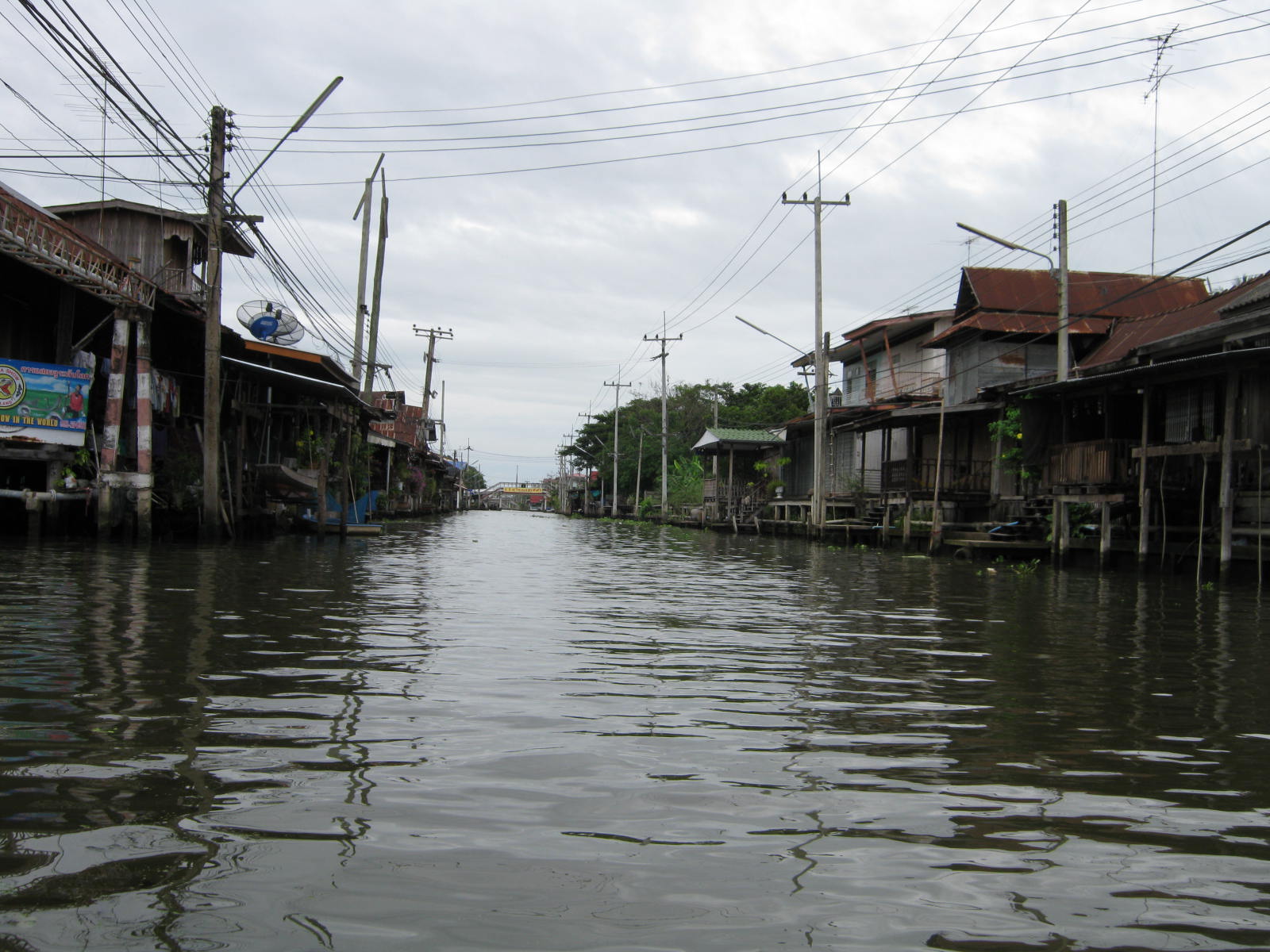
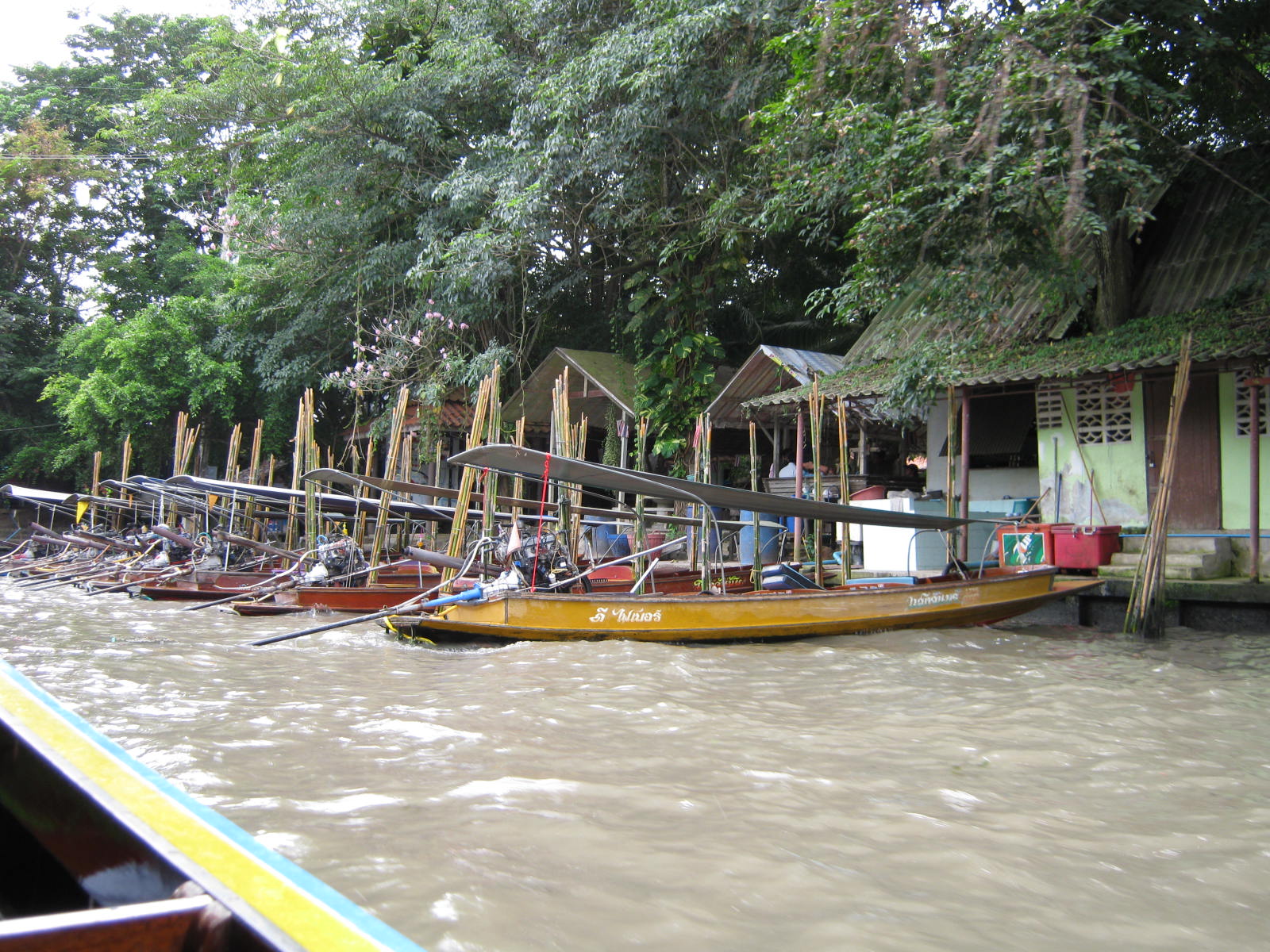
remembered. But the crowded waterway filled with row boats and tourist a very much like the pictures found on travel brochures. Although the main market was not like I remembered years ago, I found this experience more fun since my tour guide took us around the “backway” which involved taking a long-tail boat through the neighborhood. This boat ride was different since you actually get to see houses on the riverfront and seeing how to locals live by and off the river. I might have even spotted a local doing their laundry in the river. 

A row of long-tail motor boats.

Having a meet-cute in this scenario maybe a bit more difficult, but I think it would be fun to have your characters get their feet wet. You can decide if you want it to be metaphorically or literally.

  • Your main character is a photographer or explorer riding a long-tail boat and catches the eye of another person on another speeding long-tail.  
  • A character is admiring the fresh fruits from a floating vendor and happens to pick the same pineapple as another, and the vendor mistakes the pair as a couple when in fact they are two strangers.
  • A tourist exploring the floating market is trying to take a “selfie” of the bustling market and a kind handsome/beautiful stranger offers to help.

Tuesday, April 16, 2013

Cappadocia - Day 1


Day 1 in Cappadocia.

Although I wrote about traveling alone in my last blog, I'm writing about travel in Cappadocia with my friend who I met in Malta and she is also from Osaka, Japan.

Cappadocia is located in the middle of Turkey.

Map of Turkey - Valley of the Fairy Chimneys is the Cappadocia area.

Its unique land formation is a result of volcanic eruptions, with Mt. Erciyes being the highest peak in the area. Ash and lava created the large plateau, erosion of rain and wind over thousands of years caused the strange, unique rocks we find today.

In the 2nd century B.C, Christians escaped from the Roman Empire and made cave houses and underground cities in Cappadocia.

I’ll skip the history, but it’s really interesting. See here:
https://en.wikipedia.org/wiki/Cappadocia

We arrived to Nevsehir in the early morning and tried to find our free shuttle to Goreme. Each bus company has free shuttles, but finding it is not so easy. We got off the bus and a man said he was from our bus company and the shuttle hadn't came yet so we waited inside.

I doubted if he was official staff from our bus company, but we were too sleepy and tired for good judgement and we just followed him.

That was a misjudgement.

We were waiting for a long, long time but nobody came. We asked him when the shuttle comes and he just said “Soon.” Suddenly, I remembered there are people who claim to be bus staff and then put you on their tour bus, where later you have to pay.

So we went out and found a shuttle, any shuttle, and got on. But it was a different company’s shuttle. The conductor checked our tickets and said it was “Invalid.” He asked, “Where are you going?”

“Goreme.”

“This ticket is not for this company.”

He went to report us to the driver. During the wait, we were scared and worried that they might stop and throw us off the bus. Finally he came back and said, “We bring you to Goreme.”

Yhaaaaapyyyy!

Within one morning, I’d resolved to hate Turkish men, but I discovered there are good guys too. 

At last we got to Goreme.

We stayed in the Traveller's Cave Hotel (http://www.travellerscave.com/travellers_hotel/index.php
), which is the best hotel in my backpacker's life. It was on top of the hill so we got a super view and there was a terrace with comfy sofas. 


We had breakfast at the hotel and the owner told us there is a fresh market down the hill. But after a 10 hour bus ride, we weren't in the mood to explore, but we couldn’t check-in yet, so we took a nap on the comfy sofas. Then we planned to visit the fresh market after a short nap.

And the next moment we heard unbelievable words...

"Wake UP! Time for check-in!"

Goodness! We slept for 2 hours!

We gladly checked-in, and oh my goodness, our room was fabulous. It was actually a Cave. It held a pretty fireplace, table, chairs and a beautiful view out the front door.

When we prepared to go out, somebody knocked on our door. A Korean girl we met at breakfast and on the shuttle gave us fresh berries from the market because she knew we slept through the market.

First we went to Goreme Open Air Museum. 
Goreme is known as a monasterial place in 10
~12th century and there are over 10 cave churches in the Goreme Open Air Museum and over 30 in Goreme.


At the museum, we walked around the churches. I just couldn't believe they were made by manpower. There was no electronic drill at that time but every room has beautiful curves and even tables and benches are also cut from rocks.

In the cave churches are beautiful frescos. Because the cave environment provides such excellent preservation, the fresco colors are still beautiful and vivid.

To close our first day we joined the sunset tour in Rose Valley with the Korean girl. Rose Valley gets its name from Rose-colored rock. The valley is shaped like streaming curtains, beautiful drapery, and I can see the many layers that natures power has produced over millions of years.

The sunset was just fabulous, changing from orange to pink. It was a pink I've never seen before and the colors changed as the sun went down. No language holds a word for a sunset that fills one’s soul. I propose "Cappadocal." 


This is Day 1 in Cappadocia.

Character Notes:

If you are sending a character to Cappadocia, you can disrupt her happy intentions by putting her on a paid tour shuttle, or have her get kicked off the bus to Goreme and left on the road side in the middle of no where Turkey.

If your character has no hotel, she can criminally sleep on a Cappadocia balcony lounge. They are not to difficult to climb up to and the sofas are fabulous.

A chase scene through the Open Air Museum, with all the caves, churches and places to hide, would be great fun.

As the sun sets, your character, no matter how terrible her day might be, she can pause and have a Cappadocal moment.  

Thursday, April 11, 2013

The Buried Books of Herculaneum: Part 3

Philip V and Elisabetta Farese in 1743
When the booty was gone, they filled in the holes, and with no interests whatsoever in art, no such field as archeology and no apparent concept of historical preservation, there were no real records of the find.  The story might have stopped right there, had it not been for a succession of women as ambitious as Cleopatra herself...

Part 2 of this series begins the story of the excavations of Herculaneum, as we seek to unravel the answer to the Novel Travelist mystery: Why was the Villa dei Papyri never fully excavated?

Here we continue this story.

*****

Twenty-five years after d’Elboeuf abandoned the site, two factors converged to revive the excavations of Herculaneum.  The first was the ascension of a new reigning king of Naples – or rather, the true monarch - his mother.

In 1734, Naples fell under control of the “Spanish” royal dynasty controlling the Kingdom of Two Sicilies, of which neither king nor queen was actually Spanish or Sicilian.  Philip V was the French grandson of Louis XIV and was raised at the court of Versailles with aspirations of the French crown.  Instead, he was granted the lesser Spanish one.  Throughout his nominal reign, Philip suffered from a severe depression that left him categorically incapacitated most of the time.  And so his kingdom was managed by the queen.

Philip’s wife Queen Elisabetta was an Italian princess descended from the Medici dukes of Florence and the Farnese dukes of Lombardy.  On the day she rode into Madrid to marry Philip, she was greeted by Philip’s official mistress, whom Elisabetta ordered arrested and deported on the spot.  This set the tone for their marriage.

Elisabetta instated the first born son from her marriage with Philip upon the throne of Naples as the new King of Campania.  The prince was eighteen-year-old Charles.  While Charles nominally ruled the kingdom, it was his mother, Italian-born Medici Queen Elisabetta who became determined to convert the run-down, poverty- and disease-infested cesspool that was Naples into “the Florence of the South.”  And this she did, funding her ambitious endeavors by taxing the Catholic Church on its land.  As the Church was the largest landholder in Campania, tax revenues tripled.

San Carlo Opera House, Naples, 1737
Elisabetta used the newly acquired funds to build three new palaces, a royal opera house, a prison, hospices, a cemetery and a number of factories.  The palaces were intended for museums as well as for royal residences; she also set the course to transfer a vast number of pieces from the priceless Farnese collection into Naples.

At the same time, she ordered that the neglected Herculaneum excavations be resumed in hopes of finding further additions.

Under the official direction of Charles and the unofficial direction of Elisabetta, the vast cities of Herculaneum and the recently discovered Pompeii were systematically plundered.  The efforts were led by a Spanish artillery engineer, Captain Rocque Joachim Alcubierre, whose sole mission was to find everything of monetary value and pluck it from the earth.  As he exhausted one source of the buried treasure, he would delve unthinkingly into the next, backfilling each prior section with dirt from the new one.

It was under Alcubierre that the Villa dei Papiri was discovered.

Raimondo di Sangro, Prince of Sansevero and friend of King Charles, became the first to attempt opening the papyrus scrolls as they emerged from within the villa.  A self-proclaimed "gifted" and "extraordinary" alchemist, di Sangro used mercury in an effort to soften the charred, brittle papyrus.  The mercury dissolved the scrolls, and many of them were lost.

To be continued in part 4, May 9...


This blog post explores a non-fictional theme or locale that is incorporated in The Vesuvius Isotope, a new novel by Kristen Elise. Buy The Vesuvius Isotope on Amazon.

When her Nobel laureate husband is murdered, biologist Katrina Stone can no longer ignore the secrecy that increasingly pervaded his behavior in recent weeks. Her search for answers leads to a two-thousand-year-old medical mystery and the esoteric life of one of history’s most enigmatic women. Following the trail forged by her late husband, Katrina must separate truth from legend as she chases medicine from ancient Italy and Egypt to a clandestine modern-day war. Her quest will reveal a legacy of greed and murder and resurrect an ancient plague, introducing it into the twenty-first century.

Kristen Elise, Ph.D. is a drug discovery biologist and the author of The Vesuvius Isotope. She lives in San Diego, California, with her husband, stepson, and three canine children. 


Tuesday, April 9, 2013

How a Museum Lecture Becomes a Novel

Getty Center, Los Angeles, home to many inspiring and lectures.

When is an artpiece considered “Stolen?” 

Inspiration for a novel from a museum lecture. 

Stolen art can create a deep-seeded, complex conflict between families, institutions and dealers. It’s a great set-up or sub-plot for a novel.

When is a piece of art considered “Stolen?” This is an important question for any museum purchasing art and particularly of interest to that museum’s provenance hunter who must determine the pedigree of the art piece. A provenance hunter, aka: Art Detective, can be an excellent, sexy, intellectual character. 

What is Provenance? 
It’s the history of ownership of anything, but usually the term applies to art. If a piece of artwork is stolen, say by Nazis in WWII, then it’s not really owned by the museum or the auctioneer, but instead by the family, gallery or museum it was stolen from. 

I recently attended a lecture at the Getty Center on Feb. 28 by a provenance expert, Victoria Reed, from the Boston Museum of Fine Arts. (Details in Events Section.) Victoria Reed is an Art Detective and she was kind enough to entertain a packed auditorium with some of her unique provenance cases regarding art purchased after WWII.

A church filled with stolen art from Jewish families during WWII.

I’m working on a book that takes place in Amsterdam, but involves the provenance of a Titian painting which is being claimed by two different families. A Venetian family originally commissioned and owned the Titian painting, but was forced to sell it to a Dutch Jewish gallery in order to avoid it being pillaged by Napoleon’s armies. In 1936, the Nazis shut down all Jewish businesses and the Dutch Jewish Titian owner was forced to sell the painting on the black market in order to survive. The original Venetian family purchased the Titian painting on the black market. 

The conflict: Both families claim they own the Titian painting which is worth upwards of $12 million.

Adding to the conflict is that the field of provenance is still new and has few defined laws. Every situation is case by case. Victoria Reed from BMFA defined “Stolen” during WWII as a series of questions:

1. Would the sale have taken place if the Nazis were not in power? 
2. Did the owner have a choice to sell?
3. Was the owner paid money into an account that the owner controlled?

Dr. Reed then described the details of the Westfield case with regards to a 17th century Eglon van der Neer painting which BMFA purchased in 1941. Details of Painting and its provenance here: http://www.mfa.org/collections/object/portrait-of-a-man-and-woman-in-an-interior-32816

Eglon van der Neer painting (Displayed at BMFA) once owned by the Dutch Jewish family Westfield.

The case of Westfield is remarkably similar to the Dutch Jewish family I’ve created for my novel. 


-Westfield’s gallery was closed by the Nazi’s in 1936. 
-Westfield has no source of income.
-1936-38, Westfield worked with a non-Jewish gallery owner to sell his artwork, many works are presumed to have been sold on the black market. 
-Sales from the black market are not recorded.
-1938, Westfield crosses the border into France, with artwork, illegally, and makes several sales in Paris. 
-1938, Westfield is arrested for illegal movement to Paris for sale of artwork.
-1938, Westfield is sent to Auschwitz. He dies.
-1939, German catalog of Westfield’s collection shows no listing for the Eglon van der Neer painting, so it is presumed that Westfield sold it on the black market and used the money to survive. 

Now consider the questions that define if a painting is “Stolen.”
1. The sale would not have taken place, at least not on the Black Market at a reduced rate, if the Nazis were not in power.
2. The owner did not have a choice to sell. With no other source of income, it is presumed he sold the painting for survival.
3. The owner most likely received payment for the painting and he was most likely in control of the money received. 

Is the painting considered “Stolen?” According to BMFA, yes. 

An article about the Westfield case and BMFA’s restitution to the Walter Westfield family.

What does this mean for the conflict between my Venetian family and my Dutch Jewish family?
The Venetian family suffers from a statute of limitations, which states that artworks can not be claimed as stolen after a certain period. But like the Jewish families, offers of restitution could not even be put forward until long after the thefts. So suffering families of the Napoleonic pillaging feel they can claim the same right. 

This 2003 article regarding a Venetian trial of Napoleon's actions in 1797-1804 briefly describes both positive and negative views of Venetian sentiment towards Napolean:

The Accademia Gallery of Venice

In my novel the Venetian family originally commissioned the painting from Titian, thus has a historical attachment to it. The family hunted down the painting, purchased it shortly after WWII for $80,000, a great sum for a painting at that time. (The van der Neer sold to BMFA in 1941 for $7,500) At great personal cost, the family protected the painting, insured the painting and has now donated it to the Accademia Gallery of Venice, under the contracted agreement that it stays in Venice. 

The Dutch Jewish family claims that the Titian painting, now valued at $12 million, belongs to them. And according to restitution precedence, like the Westfield case, it does belong to the Dutch Jewish family. However, the Accademia Gallery can not let it leave Venice and they can not afford the multi-million dollar restitution payment. 

To add layer to the conflict, give the two families a multi-generational history of hostility against each other, toss in an innocent American provenance hunter who is trying to remain objective and not fall in love with one of the family members, and you’ve got a pretty juicy novel. 

So become a novel travelist, attend some local lectures and see what great literary adventures your mind creates. Then start planning your next research vacation!


Friday, April 5, 2013

In Van Gogh's Footsteps


Fresh from our Italian contributors, Monia & Nicola:

We travelled around Europe following Vincent van Gogh’s masterpieces among the jungle of museum in which they are displayed. Why not to follow the steps of his crazy life by looking for some of the sights that inspired his masterpieces?

So let’s go to Provence!

We jumped into the south of France with our old blue Punto to see some important places where Van Gogh spent part of his life… mile after mile we understood why Provence had been the muse of such a genius mind: the bright light, the variety of colors and the beautiful countryside inspired him to paint an endless sequence of artwork, about 200 hundred paintings in only 2 years.

We started from Arles.

The yellow house, which is the subject of one his famous paintings, unfortunately does not exist anymore. This building, in which he lived and set up his studio (Gauguin spent two months here, in which the two artists lived and painted together), was bombed during WWII and today a boulangerie stands in its place in Place Lamartine. A good baguette break!

Walking trough Arles it’s possible to visit a reconstruction of Van Gogh’s bedroom, the one he depicted several times. It is quite a touristic reproduction of the furniture and colors of the painting, but doesn’t express the feelings of the artist. However it’s an inexpensive ticket and nice to see.


Reconstruction of Van Gogh's bedroom in Arles, France

For people who want to breath Van Gogh atmosphere, while eating some local food, the best place is Café Van Gogh on Place de Forum. Do you remember the yellow bright light of the painting Le terrace du Cafè, la Nuit? That’s it! The Café was recently restored to make it as similar as possible to that depicted by Van Gogh in 1888.

The Cafe Terrace on the Place de Forum in Arles, at night

A few miles south of Arles, we reached, very late at night, the famous bridge that Van Gogh liked for its Japanese look: Pont du Langlois. This bridge is however not the one painted by the artist. Nor is it on its original site. Today we only see an identical specimen, a wooden drawbridge replaced in a landscape similar to the one seen by Van Gogh, a few kilometers downstream from the original site.

Langlois Bridge a few miles south of Arles

Saint Remy de Provence

A nice day can be spent in Saint Rémy de Provence, not far from Arles, where the asylum of Saint Paul de Mausole is located. Here, Van Gogh committed himself after he cut off his ear at the beginning of his madness.

From the window of his room you can imagine him contemplating the garden of the clinic, lavander fields and olive trees, which continues the view farther until the mountains.

Asylum in St. Remy, where Van Gogh committed himself
View from the clinic, olive trees and mountains
You can also walk the “Promenade dans l’univers de Vincent van Gogh” marked by reproductions of his artworks on easels placed exactly where the artist had his visions.

He wrote in one of his letters: ”I don’t know whether you can understand that one may make a poem only by arranging colors…”

Promenade dans l'univers de Vincent van Gogh - Painting locations


Even if most of the historic sites where Van Gogh resided during his lifetime have been destroyed by WWII, the beauty of the nature which inspired his art is still alive. Laying on the ground you can try to understand Van Gogh's emotions as you see the same night sky that moved him to paint his masterpiece The Starry Night.

We suggest this trip if you are going to visit France and if you like to experience firsthand the inspiring world behind a genius of expression!

Tuesday, April 2, 2013

The Hyderabad Washroom (observations from India)


On my first business trip to Hyderabad, India, I was visiting one of the local museums with my coworkers and I needed to use the washroom.  I did so with some trepidation; I've visited my share of public washrooms in Asia, and seen quite a few sketchy ones.  Besides a slightly bad smell (I've been in worse here in the States),  I saw a row of brand new urinals, which was a relief.  I began doing what you do at a urinal, but during the act I happened to look down and was shocked to notice a golden flow running down an open trench directly below the urinal in the floor.  Upon closer inspection, the urinal was not hooked directly into the sewage system, but instead had a hole in the bottom directly above the trench!  Ugh.

That washroom is in a sense a microcosm of what is happening in Hyderabad.  The city is modernizing at a rapid pace, but the development is not even.  Hyderabad has become a hot location for high tech companies looking for cheaper alternatives to hire highly skilled employees.  This has, in recent years, moved beyond basic outsourcing (i.e., hiring the services of an independent company located in India and subcontracting the work) to companies like mine opening full-fledged R&D divisions.  The city itself is rapidly modernizing and expanding due to the influx of capital and flood of people moving there to fill the growing job market.

The city of Hyderabad is stratified.  There are two main areas I visited: HITEC City, the newly developed IT area where my company's R&D division is located, and the Old City, where many of the tourist sites are located.  The differences between the two areas in terms of look and feel are stark.   In HITEC City, there are many areas where you could reasonably fool yourself into thinking that you were somewhere on the West Coast; there are strip malls, fancy hotels and office buildings, and plenty of expensive cars being driven around.  One thing that I found a little different was the lack of uniformity of the streets, signs, and sidewalks.  A U.S. city normally has a uniform feel in terms of the look and maintenance of its streets, but in Hyderabad, I would see pretty decent upkeep in HITEC City, but the color and consistency of the sidewalks would seem to change from block to block, as if each of the individual building owners were responsible for the roads and walkways surrounding their land.


The Old City is -- to put it bluntly -- old, and seems to fall below the standard level of city maintenance that an American would be used to.  There are a fair number of elaborate and  beautiful monuments and buildings interspersed throughout the Old City, however; due to the strong Muslim influence on design, this area of town has a very interesting feel to it.

Cell phone usage is common, although widespread use of data streaming capabilities is just coming online (3G is widely available but higher speeds are not).  Network accessibility in hotels are also widely available but speed and reliability are not quite as good as you find in the U.S.  Both the old and new parts of the city are affected by daily power outages, which typically will only last for between 10 and 30 seconds.


One of the most immediate and visceral differences between India and the U.S. is the traffic.  If you want to get an idea of what this is, search for 'Hyderbad Traffic' on YouTube.  Basically, you can imagine an intersection with cars, motorbikes, and pedestrians moving full speed in every direction at once, somehow impossibly managing to avoid collisions.  It is madness.  Even watching the video can't prepare you for the experience of actually travelling in that traffic.  A few hints: don't sit in the front seat of a car, don't bother accepting that bike ride from your Hyderbadi friend, and definitely don't try crossing the street on your own!   Cars are becoming more and more popular, and it is becoming quite common to see some quite expensive cars driving on the streets.  The motor bike is has been the preferred method of travel because you can weave in and out of traffic much more easily than you could in a car.  However, the car has a higher prestige level, which is becoming more of a factor in peoples' choice of transportation as the ranks of the middle class increases.  This has the effect of creating three tiers of simultaneous traffic speed (including the pedestrians), seemingly increasing the chaos level.  Taxis in Hyderabad are essentially passenger cabins built on top of motorbikes.  It all seems to work, however; I saw more accidents during the two hours driving from San Diego to LAX than I saw during my entire two week trip in Hyderabad!  

Although I was initially shocked by my experience in the Hyderabad washroom, in the end I decided that the experience was actually much better than many other questionable washrooms I've visited in Asia.  It was not quite what I was expecting, but like Hyderabad itself, was definitely interesting!

A few random India travel notes:

The first thing to realize when writing about a trip to India, is that it is far.  The time zone difference from Pacific Standard Time is twelve and a half hours; traveling to India from Los Angeles is about the farthest place you can go on the planet.  This means that if you are writing about a fictional character visiting India, your character will have to travel between twenty to twenty-eight hours by plane, and possibly more if he or she has to go to an outlying region by car or train from the metropolitan center.  So having your character do anything significant immediately after arriving in India is not really plausible due to the travel fatigue he or she will be experiencing.

Although India is large enough to contain multiple time zones, the government there decided to have a unified time zone for the entire country (India Standard Time or IST).  In order to accommodate this, and not have either of the two halves of the country have days that end too early or too late, they elected to have a time zone that falls between the official two hourly GMT offsets; hence the aforementioned twelve and a half hour difference.  This is unusual (but not unique to India) as most countries are offset at hourly increments from GMT.  Also, India does not observe Daylight Savings Time.  

Language is not an issue for a native English speaker visiting any of the major metropolitan areas in India.  Although Hindi is the official national language, in southern regions such as Hyderabad, it is not normally used (Telugu is the common spoken language).  Typically, when a Northern Indian and a Southern Indian communicate with each other, they will use the other national language, English.  


In my next blog, I'll be writing about two of my favorite aspects of Hyderabad: the food, and the people.